LSA vs. Google Ads: Which Should Your Trade Turn On First?
Both put you at the top of Google, but they work differently, price differently, and fit different trades. A decision guide for contractors.
By TMG USA Team
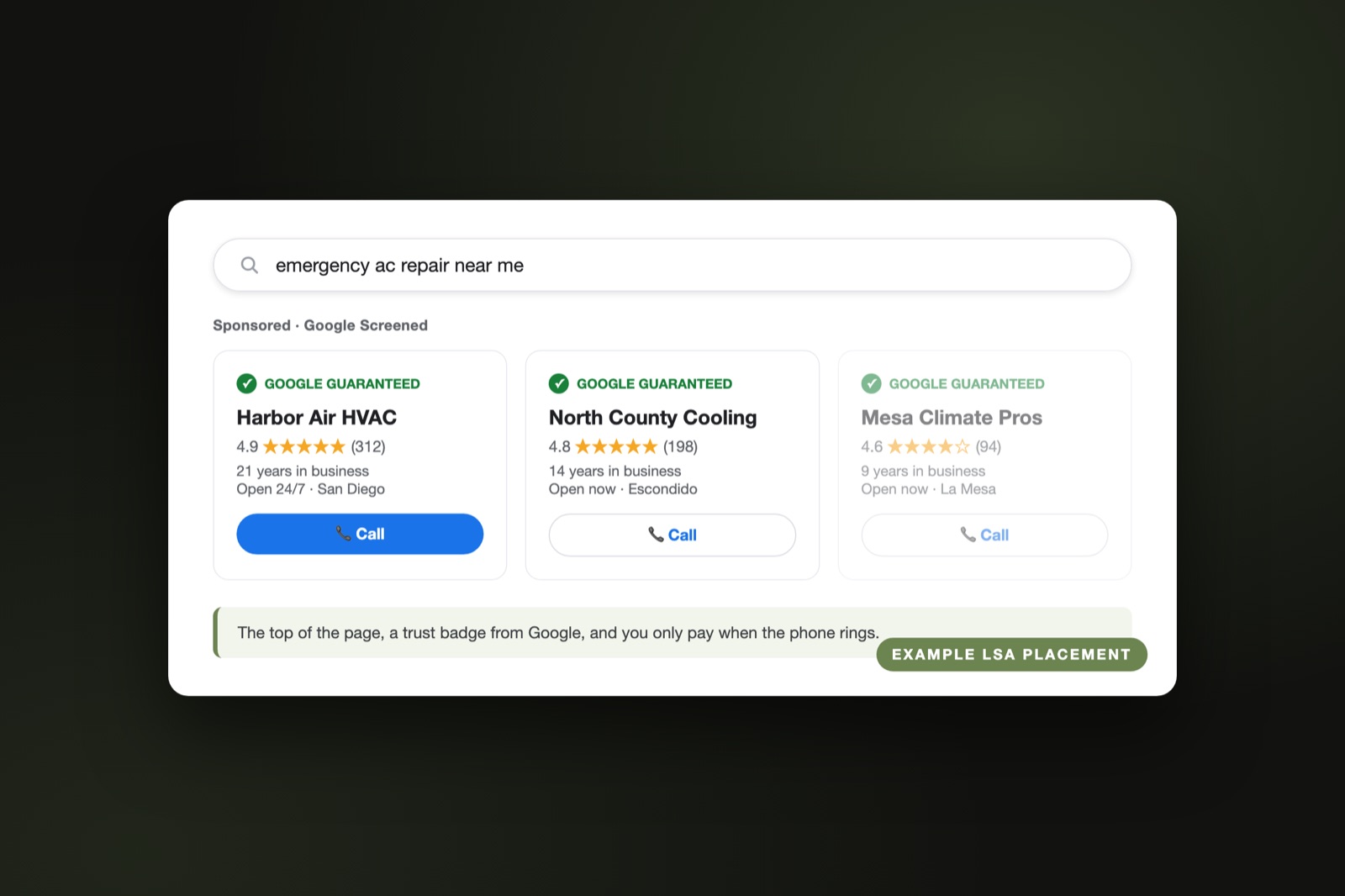
You’ve got budget for one paid Google channel to start. Two candidates sit at the top of the results page:
- Local Service Ads (LSA), the listings at the very top with the green “Google Guaranteed” checkmark
- Google Ads (PPC), the sponsored text ads just below them
Both make the phone ring. But they work so differently that starting with the wrong one for your trade can waste months. Here’s how to choose.
How they actually differ
What you pay for. LSA charges per lead, an actual call or message from a customer. Google Ads charges per click, whether or not that click ever contacts you. This single difference drives most of the strategy: LSA shifts the conversion risk to Google; PPC makes conversion your problem (and your opportunity).
How you rank. LSA placement is mostly a reputation contest, review volume and rating, how fast you answer calls, proximity to the searcher, and your bid. PPC placement is an auction plus quality: your bid, your ad relevance, and your landing page. In practice: LSA rewards operational excellence, PPC rewards marketing craft.
The trust factor. LSA comes with the Google Guaranteed badge, Google has verified your license, insurance, and background. For a nervous homeowner letting a stranger into their house, that checkmark does real persuasion work before you’ve said a word.
Control and targeting. This is where PPC pulls ahead. LSA gives you job categories and a service area, that’s roughly it. PPC lets you target exact searches (“attic insulation cost” vs. “insulation contractor”), write your own message, send traffic to a purpose-built landing page, schedule by hour, and segment by city. LSA is a powerful blunt instrument; PPC is a scalpel.
The decision rule by trade
Emergency and urgent-service trades → LSA first. HVAC, plumbing, electrical, garage doors, tree emergencies, water damage. When the customer’s problem is right now, they call from the top of the page and book whoever answers. LSA’s position, pay-per-call pricing, and trust badge are built for exactly this buyer. Your reviews and answer rate, things you control operationally, do the ranking work.
Big-ticket planned work → PPC first. Remodels, replacements, additions, pools, windows. These buyers research, compare, and take weeks to decide. You need to segment the valuable searches from the tire-kickers, make a specific case, and land people on proof, none of which LSA’s format allows. PPC’s targeting and landing-page control earn their complexity here.
Both worlds (roofing, painting, flooring, fencing)? Trades with a mix of urgent and planned work usually start with LSA for the cheaper, faster wins, then add PPC once there’s data on which planned-work searches are worth the auction.
Caveat: LSA requires passing Google’s screening, and a brand-new business with zero reviews will rank poorly at first, the reputation contest needs reputation. If that’s you, PPC may be first by default while your review base builds through your Google Business Profile.
Why mature marketing engines run both
This isn’t a permanent either/or. Contractors who stay with us almost all end up running both, because they cover each other’s blind spots:
- LSA captures the urgent caller who never scrolls past the checkmarks.
- PPC captures the researcher typing specific, high-value searches LSA can’t segment.
- When LSA lead prices spike in your category (they move with competition), PPC gives you somewhere to shift budget, and vice versa.
- PPC’s search data tells you what people in your market actually type, which sharpens everything from your LSA job categories to your SEO plan.
The endpoint is a portfolio, with budget flowing monthly toward whichever channel is producing booked jobs cheapest, that’s the whole logic of running marketing as a system instead of a tactic.
The honest checklist before you spend on either
- Can you answer the phone? LSA punishes missed calls with worse rankings, and every paid lead you miss is money burned. If answering is shaky, fix that first, it’s cheaper than any ad.
- Do you have reviews? Under a handful, LSA will struggle; build the review pipeline in parallel.
- Does your website convert? For PPC especially, paying for clicks that land on a slow, unconvincing site is the most common way contractors decide “ads don’t work.”
- Do you know your max lead cost? If not, read our lead cost math guide first. Both channels are easy to evaluate once you know your number, and impossible to evaluate without it.
Still not sure which fits your trade and market? That’s a fifteen-minute conversation with real local data. Book a free strategy call and we’ll show you what both channels actually cost in your area, and which one we’d turn on first if it were our money.